
— Wildfire detection · Edge AI · Real Time
Autonomous wildfire detection.
Embedded. Real-time.
No cloud dependency.
NVIDIA Jetson Orin NX · C++ / DeepStream · L1 → L2 → L3 Kill Chain
NumidAI turns a single edge device and any RTSP camera into an autonomous wildfire monitoring system — designed to detect weak smoke signals and verify them locally before issuing an alert.
The system uses a staged on-device verification pipeline: a first detection layer scans continuously, deeper analysis stages re-check persistent candidates, and only consistent signals are escalated.
Built for real-world outdoor conditions, NumidAI is designed to separate credible wildfire smoke from common visual confusers while running fully on-device.
Technical demonstrator. Open to discussions around pilot validation in real-world conditions from Summer 2026 onward.
Demo
Two real-world cases: prescribed burn detection · industrial plume rejection
Kill Chain
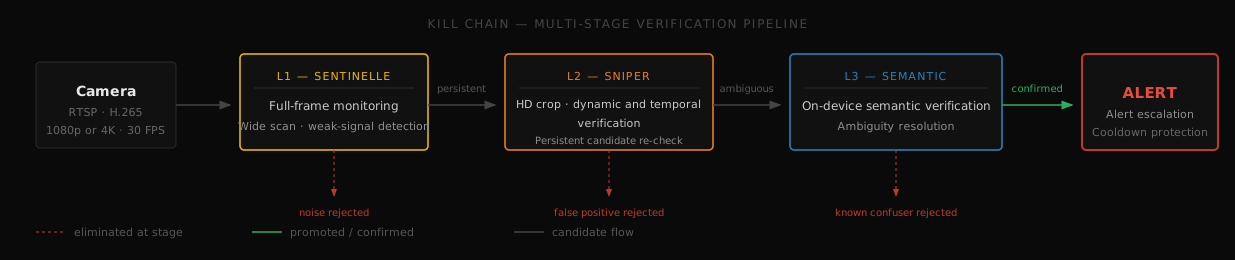
L1 — Sentinelle
Wide scan · Weak-signal detection
Wide-area continuous detection, built to pick up weak and uncertain signals early.
L2 — Sniper
HD crop · Dynamic and temporal verification
Persistent candidates are re-checked locally through higher-fidelity analysis, with dynamic and temporal consistency checks used to distinguish stable smoke signals from transient artifacts before escalation.
L3 — Semantic
On-device source classification · Ambiguity resolution
Ambiguous survivors go through a final on-device semantic verification stage, designed to identify known non-threat sources and resolve the remaining uncertainty before alert escalation.
Stack
Hardware
- NVIDIA Jetson Orin NX 16 GB
- Any IP camera · RTSP H.264/H.265
- No cloud compute required
Software
- C++20 · NVIDIA DeepStream 7.x
- YOLOv8m · TensorRT FP16
- Embedded semantic model
- Lock-free async architecture
Contact
For field validation partnerships, technical collaboration, or any inquiry — see the About page →